 products, the rate law may be first order:
A rate law tells us how the rate of a reaction changes at a particular temperature as we change reactant concentrations. Rate laws can be converted into equations that tell us what the concentrations of the reactants or products are at any time during the course of a reaction. The mathematics required involves calculus. We don't expect you to be able to perform the calculus operations; however, you should be able to use the resulting equations. We will apply this conversion to two of the simplest rate laws: those that are first-order overall and those that are second-order overall.
A first-order reaction is one whose rate depends on the concentration of a single reactant raised to the first power. For a reaction of the sort A products, the rate law may be first order:
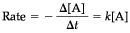
Using calculus, this equation can be transformed into an equation that relates the concentration of A at the start of the reaction, [A]0, to its concentration at any other time t, [A]t:

[14.13]
The function "ln" is the natural logarithm (Appendix A.2 of the textbook). (In terms of base-10 or common logarithms, Equation 14.13 can be written as

The factor 2.303 arises from the conversion of natural logarithms to base-10 logarithms.)
Equation 14.13 can be rearranged:

[14.14]
This equation has the form of the general equation for a straight line, y = mx + b, in which m is the slope and b is the y-intercept of the line (see Appendix A.4):

Thus, for a first-order reaction a graph of ln[A]t versus time gives a straight line with a slope of -k and a y-intercept of ln[A]0.
As an example of a first-order reaction, we can consider the conversion of methyl isonitrile, CH3NC, to acetonitrile, CH3CN (Figure 14.6). Because experiments show that the reaction is first order, we can write the rate law:

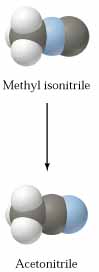
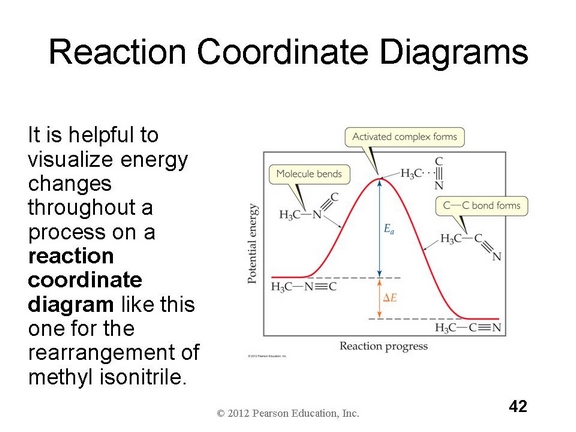
Figure 14.6 The transformation of methyl isonitrile, CH3NC, to acetonitrile, CH3CN, is a first-order process. Methylisonitrile and acetonitrile are isomers, molecules that have the same atoms arranged differently. This reaction is called an isomerization reaction.
Figure 14.7(a) shows how the partial pressure of methyl isonitrile varies with time as it rearranges in the gas phase at 198.9°C. We can use pressure as a unit of concentration for a gas because, from the ideal-gas law, the pressure is directly proportional to the number of moles per unit volume. Figure 14.7(b) shows a plot of the natural logarithm of the pressure versus time, a plot that yields a straight line. The slope of this line is -5.1  10–5 s–1. (You should verify this for yourself, remembering that your result may vary slightly from ours because of inaccuracies associated with reading the graph.) Because the slope of the line equals -k, we see that the rate constant for this reaction equals 5.1 10–5 s–1.
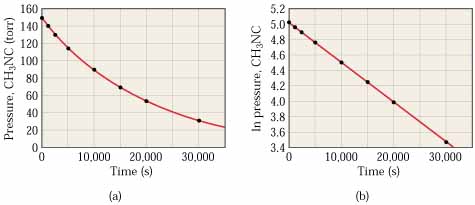
Figure 14.7 (a) Variation in the partial pressure of methyl isonitrile, CH3NC, with time at 198.9°C during the reaction CH3NC CH3CN. (b) A plot of the natural logarithm of the CH3NC pressure as a function of time.
For a first-order reaction, Equation 14.13 or 14.14 can be used to determine (1) the concentration of a reactant remaining at any time after the reaction has started, (2) the time required for a given fraction of a sample to react, or (3) the time required for a reactant concentration to reach a certain level.

The first-order rate constant for the decomposition of a certain insecticide in water at 12C is 1.45 yr-1. A quantity of this insecticide is washed into a lake on June 1, leading to a concentration of 5.0 10–7 g/cm3 of water. Assume that the effective temperature of the lake is 12C. (a) What is the concentration of the insecticide on June 1 of the following year? (b) How long will it take for the concentration of the insecticide to drop to 3.0 10 –7 g/cm3?
PROBLEM 2
The decomposition of dimethyl ether, (CH3)2O, at 510 °C is a first-order process with a rate constant of 6.8 10–4 s–1.

If the initial pressure of (CH3)2O is 135 torr, what is its partial pressure after 1420 s?
The half-life of a reaction, t1/2, is the time required for the concentration of a reactant to drop to one half of its initial value,  We can determine the half-life of a first-order reaction by substituting
  into Equation 14.13:



[14.15]
Notice that t1/2 for a first-order rate law is independent of the initial concentration of reactant. Thus, the half-life is the same at any time during the reaction. If, for example, the concentration of the reactant is 0.120 M at some moment in the reaction, it will be  (0.120 M) = 0.060 M one half-life later. After one more half-life passes, the concentration will drop to 0.030 M, and so on. The concept of half-life is widely used in describing radioactive decay. This application is discussed in detail in Section 21.4.
The data for the first-order rearrangement of methyl isonitrile at 198.9°C are graphed in Figure 14.8. The first half-life is shown at 13,300 s. At a time 13,300 s later, the isonitrile concentration has decreased to one half of one half, or one-fourth the original concentration. In a first-order reaction the concentration of the reactant decreases by  in each of a series of regularly spaced time intervals, namely, t1/2.
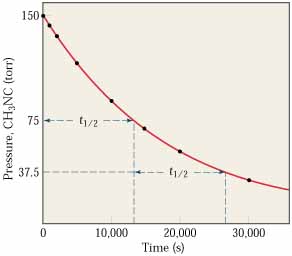
Figure 14.8 Pressure of methyl isonitrile as a function of time. Two successive half-lives of the isomerization reaction, Figure 14.6, are shown.
USing SLIDE 13 (chapter slides) estimate the half-life of the reaction of C4H9Cl with water.
Using SLIDE 10 (chapter slides), calculate t1/2 for the reaction described in Problem 3.
A second-order reaction is one whose rate depends on the reactant concentration raised to the second power or on the concentrations of two different reactants, each raised to the first power. For simplicity let's consider reactions of the sort A products, or A + B products. If such a reaction is second order in just one reactant, A, the rate law is given by

Relying on calculus, this rate law can be used to derive the following equation:
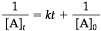
[14.16]
This equation, like Equation 14.14, has the form of a straight line (y = mx + b). If the reaction is second order, a plot of 1/[A]t versus t will yield a straight line with a slope equal to k and a y-intercept equal to 1/[A]0. One way to distinguish between first- and second-order rate laws is to graph both ln[A]t and 1/[A]t against t. If the ln[A]t plot is linear, the reaction is first order; if the 1/[A]t plot is linear, the reaction is second order.
Using Equation 14.16, we can show that the half-life of a second-order reaction is

[14.17]
We see that, unlike the half-life of first-order reactions, the half-life of a second-order reaction is dependent on the initial concentration of reactant.
The following data were obtained for the gas-phase decomposition of nitrogen dioxide at 300°C, NO2(g) NO(g) +  O2(g):

Is the reaction first or second order in NO2?
What is the half-life from time t = 0 for the decomposition of NO2, as represented by the tabular data above?
A reaction may also be second order by having a first-order dependence of the rate on each of two reagents; that is, rate = k[A][B]. It is possible to derive an expression for the variation in concentrations of A and B with time. However, we will not consider this and other more complicated rate laws here.