| |

402 CH4 Section 2 Reading guide and Problems: KEY
- What is a machine?
A machine is a device with moving parts that
work together to accomplish a task
- What is input and output in regards to a machine?
The input force is the force you apply to
the machine. The output force is the force the machine applies to what you
are trying to move.
- What is input force (Force applied) and output force (Force moved) in regards to a lever?
The input force is the force you push on the lever.
The output force is the force the machine applies to the object (rock, object in wheelbarrow, walnut you are trying to crack).
- What is the equation for mechanical advantage given in the book? What is the actual mechanical advantage equation given in class?
MA = Fo ÷ Fi
AMA = Force moved ÷ Force applied
- What is the (actual) mechanical advantage of a lever that allows a girl to lift a 30-newton box with a force of 5 newtons?
AMA = Force moved ÷ Force applied
AMA = 30 ÷ 5 = 6
- What are the six simple machines that were discussed in class?
Lever, incline plane, wedge, pulley, screw, wheel and axle
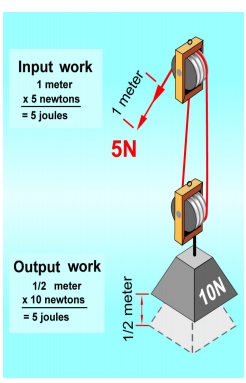
- Explain with the pulley system on page 94 how work (energy) is conserved with a simple machine.
pulley
- What is true for all machines?
The output work of a machine can never be greater than the input work. This
is a rule that is true for all machines. Nature does not give something for
nothing.
- The input force must be applied over a _____________ distance to satisfy the rule for input and output.
Longer
- A jack is used to lift one side of a car in order to replace a tire. To lift the car, the jack handle moves
30 centimeters for every one centimeter that the car is lifted. If a force of 100 newtons is applied to
the jack handle, what force is applied to the car by the jack? You can assume all of the input work
equals output work (no friction).
100N * 30 = 3,000N
- Two movers use a pulley to lift a 2,000-newton piano up to the second floor. Each time he pulls
the rope down 1 meters (input distance), the piano moves up 0.33 meter (output distance).
With what force do the movers pull on the rope?
1.00m/0.33m = Mechanical advantage of 3
2,000N/3 = 667N
- A nutcracker is a very useful lever. The center of the nutcracker (where the nut is) moves
one centimeter for each 2.50 centimeters your hand squeezes down. If a force of 50 newtons
is needed to crack the shell of a walnut, what force must you apply?
2.50cm/1.0cm = Mechanical advantage of 2.5
50N/2.5 = 20N
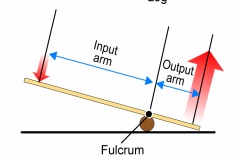
- Diagram all the parts of a lever?
lever
- What is the equation to determine the Ideal Mechanical Advantage (IMA) of a lever?
input arm / output arm = IMA
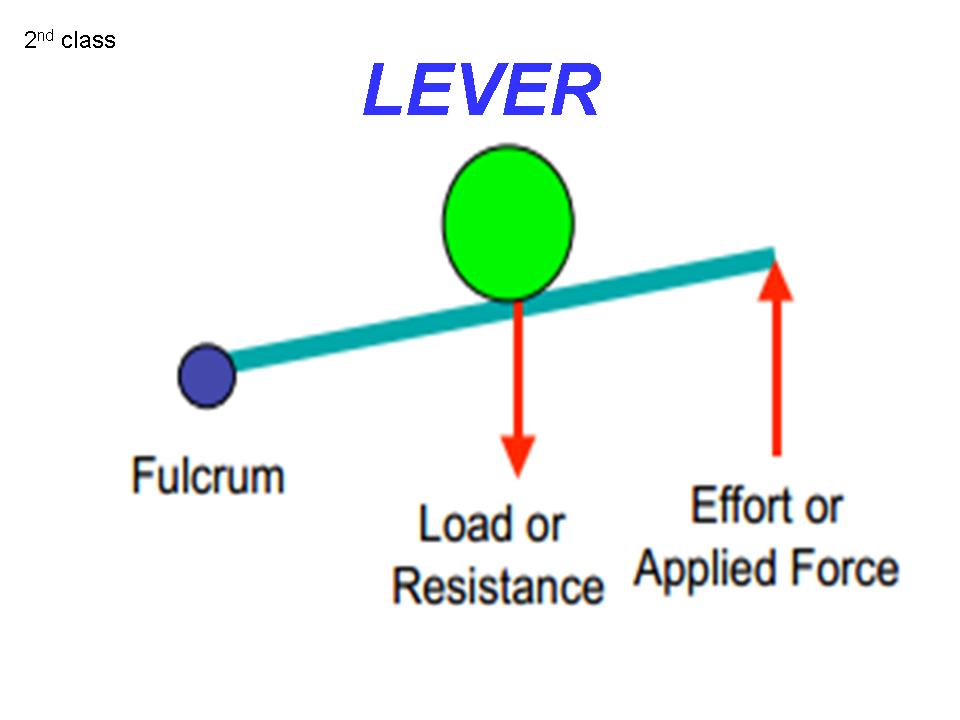
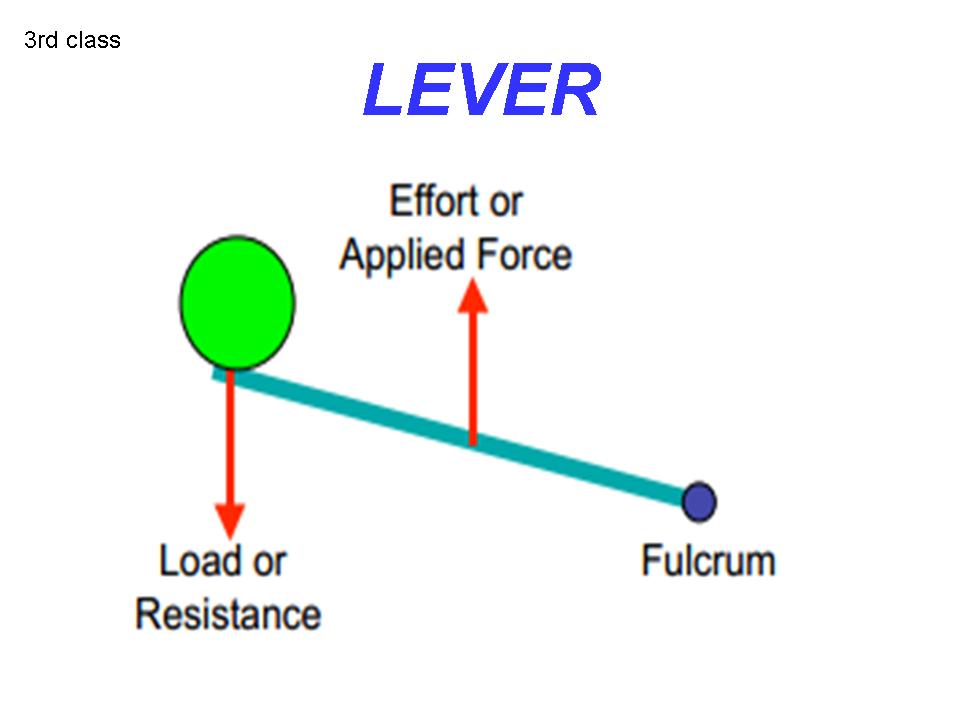
- What are the three different classes of lever? Diagram each one (again). Makes sure you can tell the differences between them.
lever 1 lever 2 lever 3
- The mechanical advantage of each lever is always determiend by what?
You can find the mechanical advantage of a lever by looking at two triangles.
The output work is the output force multiplied by the output distance. The
input work is the input distance multiplied by the input force. By setting the
input and output work equal, you see that the ratio of forces is the inverse of
the ratio of distances. The larger (input) distance has the smaller force. The
ratio of distances is equal to the ratio of the lengths of the two arms of the
lever. Using the lengths of the arms is the easiest way to calculate the
mechanical advantage of a lever (below).
- What determines the mechanical advantage of a pulley?
The mechanical advantage of a pulley system depends on the number of
strands of rope directly supporting the load.
- How do you determine the mechanical advantage of a gear?
The rule for how two gears turn depends on the number of teeth on each gear.
The teeth don’t slip, so moving 36 teeth on one gear means that 36 teeth have
to move on any connected gear. Suppose a large gear with 36 teeth is
connected to a small gear with 12 teeth. As the large gear turns once around, it
moves 36 teeth on the smaller gear. The smaller gear must turn three times
(3 × 12 = 36) for every single turn of the large gear (Figure 4.13).
- How do you determine the mechanical advantage of a ramp or inclined plane?
For a frictionless ramp, the mechanical
advantage is the length of the ramp divided by the height
- How do you determine the mechanical advantage of a screw?
(2πL) ÷ P
L = length of the arm of rotation
P = pitch which is the distance between the threads of the screw
- A lever has an input force of 5 newtons and an output force of
15 newtons. What is the mechanical advantage of the lever?
15/5 = AMA
3 = AMA
- A simple machine has a mechanical advantage of 5. If the output
force is 10 N, what is the input force?
10N/5 = 2 AMA
- You use a rope and pulley system with a mechanical advantage of 5.
How big an output load can you lift with an input force of 200 N?
200N * 5 = 1000N
- A lever has an input arm 50 cm long and an output arm 20 cm long.
a. What is the mechanical advantage of the lever?
b. If the input force is 100 N, what is the output force?
50cm/20cm = 2.5 IMA
100N * 2.5 = 250N
- You want to use a lever to lift a 2000 N rock. The maximum force you
can exert is 500 N. Draw a lever that will allow you to lift the rock.
Label the input force, output force, fulcrum, input arm, and output
arm. Specify measurements for the input and output arms. State the
mechanical advantage of your lever.
4m input arm and 1m output arm = 4 IMA
500N * 4 = 2000N
- A rope and pulley system is used so that a 20 N force can lift a 60 N
weight. What is the minimum number of ropes in the system that
must support the weight?
60N/20N = 3 ropes supporting the weight
- A rope and pulley system has two ropes supporting the load.
a. Draw a diagram of the pulley system.
b. What is its mechanical advantage?
c. What is the relationship between the input force and the output
force?
d. How much can you lift with an input force of 20 N?
answers will vary, call on students to provide examples on the board
- You push a heavy car weighing 500 newtons up a ramp. At the top of
the ramp, it is 2 meters higher than it was initially.
a. How much work did you do on the car?
W = mgh
W = 500N * 2
W = 1000J
b. If your input force on the car was 200 newtons, how long is the
ramp?
500N / 200N = 2.5
2.5 * 2m = 5m
|