| |

1307 Ohm's Law and Coulombs Problems
- Write all answers in your bound journal
- Make it NEAT and in COMPLETE SENTENCES, clearly identify which section you are working (using numbers)
- Box final answers if doing math.
- -4pt if you do not title and date the entry
- -1pt (per infraction) if you do not clearly identify the sections, or number the problems
In terms of SI base units, the coulomb(C) is the equivalent of one ampere-second.
Conversely, an electric current of 1.00A represents 1.00C of unit electric charge carriers flowing past a specific point in 1.00 seconds.
The unit electric charge is the amount of charge contained in a single electron. Thus, 6.24 x 10¹⁸ electrons have 1.00C of charge
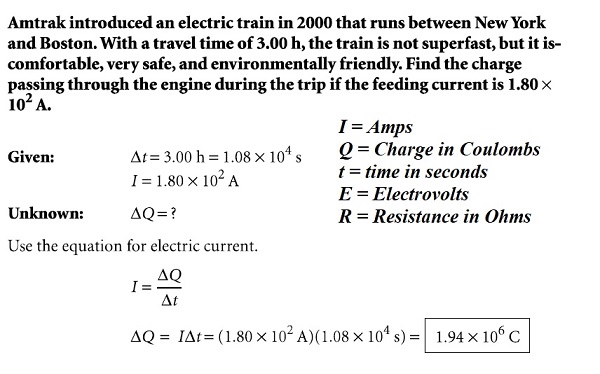 Problems Section 1
- An 8.00 × 10⁶kg electromagnet built in Switzerland draws a current of
3.00 × 10² A. How much charge passes through the magnet in 2.40 min?
- On July 16, 2186, a total solar eclipse lasting 7 min, 29 s, will be observed
over the mid-Atlantic Ocean. During the eclipse, an observer may need a
flashlight to see. If the flashlight draws a current of 0.220 A, how much
charge will pass through the light bulb during the eclipse?
- The National Institute of Standards and Technology has built a clock that
is off by only 3.30µs a year. Consider a current of 0.880 A in a wire. How
many electrons pass through a cross-section of the wire in 3.30 × 10⁻⁶ s?
- In England, a miniature electric bicycle has been constructed. The Ni-Cd
batteries help the rider pedal for up to 3.00 h. If a charge of 1.51 × 10⁴ C
passes through the motor during those 3.00 h, what is the current?
- Because high-temperature superconducting cables cannot sustain high
currents, their applicability is limited. However, a prototype of a hightemperature
superconductor that can transfer a charge of 1.80 × 10⁵ C in
6.00 min has been constructed. To what current does this correspond?
- In 1994, a prototype of what was claimed to be the first “practical” electric
car was introduced. Recharging the batteries is not very practical,
though. Calculate the average time needed to recharge the car’s batteries
if a 13.6 A current carries 4.40 × 10⁵ C to the batteries.
Problems Section 2
- A total charge of 76 C passes through a cross-sectional area of a copper
wire in 19 s. What is the current in the wire?
- A total charge of 114µC passes through a cross-sectional area of an
aluminum wire in 0.36 s. What is the current in the wire?
- A total charge of 29 mC passes through a cross-sectional area of a
nichrome wire in 11 s. What is the current in the wire?
- If a current in a wire of a telephone is 1.4 A, how long would it take for
98 C of charge to pass a point in this wire?
- If a current in a wire of a vacuum cleaner is 9.65 A, how long would it
take for 30.9 C of charge to pass a point in this wire?
- If a current in a wire of a blender is 7.8 A, how long would it take for
56 C of charge to pass a point in this wire?
- A photocopy machine draws 9.3 A when it starts up. If the start-up
time is 15 s, how much charge passes a cross-sectional area of the circuit
in this time?
- A computer draws 3.0 A when it starts up. If the start-up time is
2.0 min, how much charge passes a cross-sectional area of the circuit in
this time?
- A printer draws 0.70 A when it starts up. If the start-up time is
2.0 s, how much charge passes a cross-sectional area of the circuit in
this time?
- A space heater draws 5.6 A when it starts up. If the start-up time is 4.3 s,
how much charge passes a cross-sectional area of the circuit in this
time?
Problems Section 3
- Electric eels, found in South America, can provide a potential difference
of 440 V that draws a current of 0.80 A through the eel's prey. Calculate
the resistance of the circuit (the eel and prey).
- It is claimed that a certain camcorder battery can provide a potential difference
of 9.60 V and a current of 1.50 A. What is the resistance through
which the battery must be discharged?
- A prototype electric car is powered by a 312 V battery pack. What is the
resistance of the motor circuit when 2.8x10⁵C passes through the circuit
in 1.00 h?
- In 1992, engineers built a 2.5 mm long electric motor that can be driven
by a very low emf. What is the potential difference if it draws a 3.8 A current
through a 0.64 Ω resistor?
- A team from Texas A&M University has built an electric sports car with a
maximum motor current of 2.4x10³ A. Determine the potential difference
that provides this current if the circuit resistance is 0.30 Ω.
- Stanford University scientists have constructed the Orbiting Picosatellite
Automated Launcher (OPAL). OPAL can launch disposable "picosatellites"
the size of hockey pucks. Each picosatellite will be powered by a
3.0 V battery for about an hour. If the satellite's circuitry were to have a
resistance of 16 Ω, what current would be drawn by the satellite?
- For years, California has been striving for all zero-emission vehicles on
its roads. In 1995, a street bus with a range of 120 km was built. This bus
is powered by batteries delivering 6.00x10²V. If the circuit resistance is
4.4 Ω, what is the current in the bus's circuit?
Problems Section 4
- You have probably heard that high-voltages are more dangerous than low voltages.
To understand this, assume that your body has a resistance of 1.0x10⁵ Ω. What potential difference would have to be across
your body to produce a current of 1.0 mA (which would cause a tingling
feeling) and 15 mA (a fatal amount of current)?
- A battery-powered electric lantern is used as a light source for camping.
The light bulb in the lantern has a resistance of 6.4 Ω. Assume that
the rest of the lantern's circuit has no resistance and that the current
through the circuit is 0.75 A. Calculate the potential difference across
the lantern's battery.
- Some kitchen sinks are equipped with electric garbage disposals. These
are units with rapidly rotating steel blades, which are able to crush and
chop up food so that it can be washed down the drain instead of taking
up space as solid garbage. The motor of a garbage disposal has a resistance
of about 25.0 Ω. If the current through the motor equals 4.66 A,
what is the potential difference across the motor's terminals?
- A washing machine motor carries a current through a circuit with a resistance
of 12.2 Ω. If the washing machine is plugged into a 120 V outlet,
what is the current in the motor?
- If you were to swim in the Atlantic Ocean off the coast of Brazil, the resistance
of your body could drop as low as 1.0x10² Ω. An electric eel
in Brazil can have a potential difference of up to 650 V across it. If you
came into contact with this eel while swimming, what current would
be delivered to your body?
- When traveling to another country, you should always find out the
voltage that is used in that country before you plug in an appliance. To
understand the reason for this precaution, calculate the current that a
laptop computer would draw from a 120 V outlet in the United States
if the computer has a resistance of 40.0 Ω. Then, calculate the current
that the same computer would draw if you plugged it into a 240 V outlet
in the United Kingdom.
- A television set is plugged into a 120 V outlet. The television circuit
carries a current equal to 0.75 A. What is the overall resistance of the
television set?
- An electric car is equipped with an electric motor that can deliver
50 horsepower. The voltage across the motor's terminals equals 5.00x10²V, and the current through the motor is 0.89 A.What is the resistance
in the motor's circuit?
- A medium-sized household oscillating fan draws 545 mA of current
when the potential difference across its motor is 120 V. How large is the
fan's resistance?
- A refrigerator's circuit carries a current equal to 0.65 A when the voltage
across the circuit equals 117 V. How large is the resistance of the refrigerator's
circuit?
|