| |

406 Six simple Machines Problems
For each machine problem below:
1pt) Diagram and label the machine with appropriate numbers
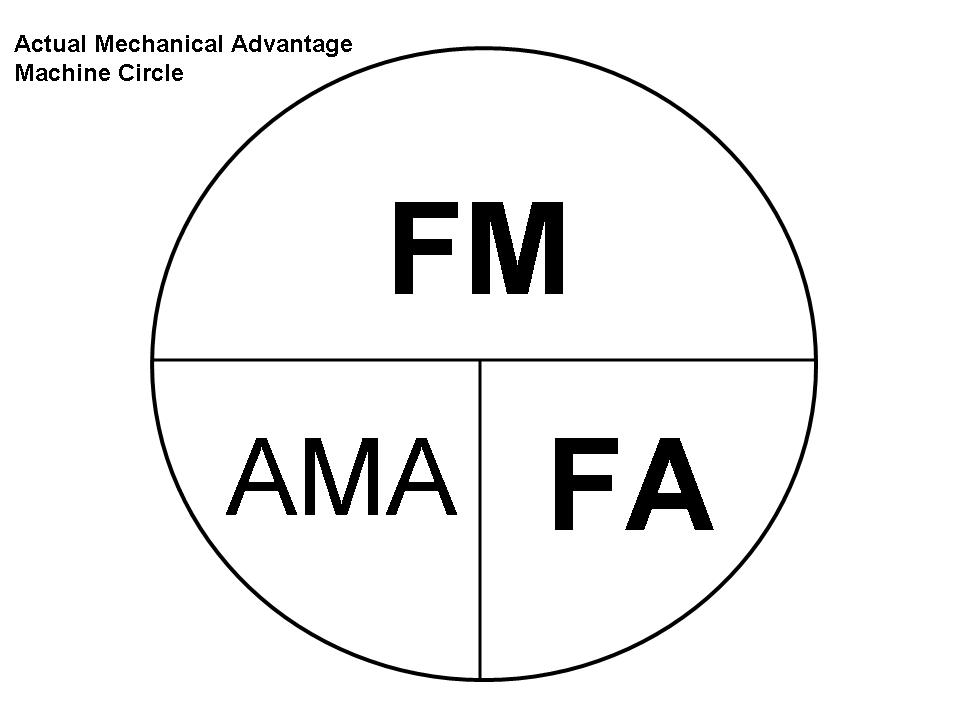
2pt) Determine the ideal mechanical advantage and the actual mechanical advantage
1pt) Determine the efficiency of the machine
24pts
- Lever that is 1.00 meter on one side and 9.00 meters on the other is able to lift a 70.0N weight using only 10.0N.
- An incline plane that is 3.00 meters high and 8.00 meters long can raise an 82.0N package using 44.0N of force up the plane.
- Design a pulley system that that can lift 100.0N using only 55.0N of force.
- A wedge that is 8.00cm wide and 24.0cm long is used to spilt wood apart by using 200.0N of downward force to produce 550.0N of separation force.
- A jack with a screw pitch of 0.0400m and a 1.00m long handle is able to raise a 1000.0N car using 20.00N of force.
- A 1.00m radius wheel fixed to a 0.100m radius axle is used to raise a 50.00N bucket of water using 10.0N.
For each machine:
- 1pt) Diagram the machine
- 2pt) Determine the missing value
18pts
- Lever that is 1.00 meter on one side and 9.00 meters on the other is able to lift a 100.0N weight with 97.0% efficiency.
- An incline plane that is 4.00 meters high and 12.00 meters long can raise an 800.0N package with 70.0% efficiency.
- A tire jack with a screw pitch of 0.0500m and a 1.00m long handle works at 70.0% efficiency. What is the maximum weight of the car that can be lifted using 20.0N of force?
- A 1m radius wheel fixed to a 0.200m radius axle functions at 80.0% efficiency. How heavy of a weight could you lift if you use 10.00N of force turning the wheel?
- A pulley with a ideal mechanical advantage of 4.00 that lifts a 120.N load with 78.0% efficiency.
- What is the amount of applied force needed to split a log with 300.0N of separation force (outward total). If the wedge is 20.0cm long and 6.00cm at the base but only works at 60.0% efficiency?
|