Ray Kurzweil’s Mind-Boggling Predictions for the Next 25 Years
BY PETER DIAMANDISON JAN 26, 2015| FEATURED, FUTURE, SINGULARITY 376,070 53
(lifted from http://singularityhub.com/2015/01/26/ray-kurzweils-mind-boggling-predictions-for-the-next-25-years/)
In my new book BOLD, one of the interviews that I’m most excited about is with my good friend Ray Kurzweil.
Bill Gates calls Ray, “the best person I know at predicting the future of artificial intelligence.” Ray is also amazing at predicting a lot more beyond just AI.
This post looks at his very incredible predictions for the next 20+ years.
So who is Ray Kurzweil?
He has received 20 honorary doctorates, has been awarded honors from three U.S. presidents, and has authored 7 books (5 of which have been national bestsellers).
He is the principal inventor of many technologies ranging from the first CCD flatbed scanner to the first print-to-speech reading machine for the blind. He is also the chancellor and co-founder of Singularity University, and the guy tagged by Larry Page to direct artificial intelligence development at Google.
In short, Ray’s pretty smart… and his predictions are amazing, mind-boggling, and important reminders that we are living in the most exciting time in human history.
But, first let’s look back at some of the predictions Ray got right.
Predictions Ray has gotten right over the last 25 years
In 1990 (twenty-five years ago), he predicted…
- that a computer would defeat a world chess champion by 1998. Then in 1997, IBM’s Deep Blue defeated Garry Kasparov.
- that PCs would be capable of answering queries by accessing information wirelessly via the Internet by 2010. He was right, to say the least.
- that by the early 2000s, exoskeletal limbs would let the disabled walk. Companies like Ekso Bionics and others now have technology that does just this, and much more.
In 1999, he predicted…
- that people would be able talk to their computer to give commands by 2009. While still in the early days in 2009, natural language interfaces like Apple’s Siri and Google Now have come a long way. I rarely use my keyboard anymore; instead I dictate texts and emails.
- that computer displays would be built into eyeglasses for augmented reality by 2009. Labs and teams were building head mounted displays well before 2009, but Google started experimenting with Google Glass prototypes in 2011. Now, we are seeing an explosion of augmented and virtual reality solutions and HMDs. Microsoft just released the Hololens, and Magic Leap is working on some amazing technology, to name two.
In 2005, he predicted…
- that by the 2010s, virtual solutions would be able to do real-time language translation in which words spoken in a foreign language would be translated into text that would appear as subtitles to a user wearing the glasses. Well, Microsoft (via Skype Translate), Google (Translate), and others have done this and beyond. One app called Word Lens actually uses your camera to find and translate text imagery in real time.
Ray’s predictions for the next 25 years
The above represent only a few of the predictions Ray has made.
While he hasn’t been precisely right, to the exact year, his track record is stunningly good.
Here are some of my favorite of Ray’s predictions for the next 25+ years.
- If you are an entrepreneur, you need to be thinking about these. Specifically, how are you going to capitalize on them when they happen? How will they affect your business?
- By the late 2010s, glasses will beam images directly onto the retina. Ten terabytes of computing power (roughly the same as the human brain) will cost about $1,000.
- By the 2020s, most diseases will go away as nanobots become smarter than current medical technology. Normal human eating can be replaced by nanosystems. The Turing test begins to be passable. Self-driving cars begin to take over the roads, and people won’t be allowed to drive on highways.
- By the 2030s, virtual reality will begin to feel 100% real. We will be able to upload our mind/consciousness by the end of the decade.
- By the 2040s, non-biological intelligence will be a billion times more capable than biological intelligence (a.k.a. us). Nanotech foglets will be able to make food out of thin air and create any object in physical world at a whim.
- By 2045, we will multiply our intelligence a billionfold by linking wirelessly from our neocortex to a synthetic neocortex in the cloud.
- Ray’s predictions are a byproduct of his (and my) understanding of the power of Moore’s Law, more specifically Ray’s “Law of Accelerating Returns” and of exponential technologies. (SEE BELOW)
- These technologies follow an exponential growth curve based on the principle that the computing power that enables them doubles every two years.
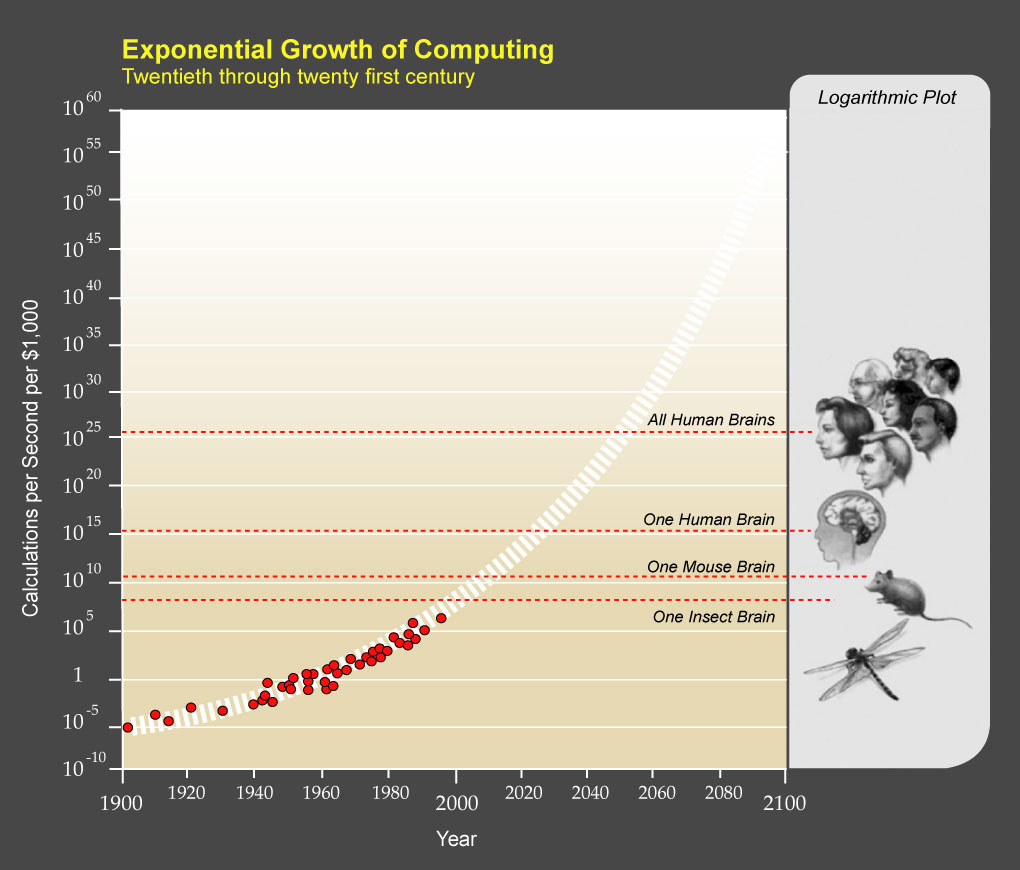
The Law of Accelerating Returns Applied to the Growth of Computation
http://www.kurzweilai.net/the-law-of-accelerating-returns
The following provides a brief overview of the law of accelerating returns as it applies to the double exponential growth of computation. This model considers the impact of the growing power of the technology to foster its own next generation. For example, with more powerful computers and related technology, we have the tools and the knowledge to design yet more powerful computers, and to do so more quickly.
Note that the data for the year 2000 and beyond assume neural net connection calculations as it is expected that this type of calculation will ultimately dominate, particularly in emulating human brain functions. This type of calculation is less expensive than conventional (e.g., Pentium III / IV) calculations by a factor of at least 100 (particularly if implemented using digital controlled analog electronics, which would correspond well to the brain’s digital controlled analog electrochemical processes). A factor of 100 translates into approximately 6 years (today) and less than 6 years later in the twenty-first century.
My estimate of brain capacity is 100 billion neurons times an average 1,000 connections per neuron (with the calculations taking place primarily in the connections) times 200 calculations per second. Although these estimates are conservatively high, one can find higher and lower estimates. However, even much higher (or lower) estimates by orders of magnitude only shift the prediction by a relatively small number of years.
Some prominent dates from this analysis include the following:
We achieve one Human Brain capability (2 * 10^16 cps) for $1,000 around the year 2023.
We achieve one Human Brain capability (2 * 10^16 cps) for one cent around the year 2037.
We achieve one Human Race capability (2 * 10^26 cps) for $1,000 around the year 2049.
We achieve one Human Race capability (2 * 10^26 cps) for one cent around the year 2059.
